 Manage Conflict - Resolve Conflict - Prevent Conflict
 Menu
- Our Conflict Management Tools
- FREE: A Brief Conflict-Provoking Communication Self-Assessment
- Conflict Articles By Bacal
- Mega Conflict Management Library
- Guest Contributions - Conflict Management and Conflict Resolution
- Free Instructional Videos On Conflict
- Browse Our Conflict Related Mni-Guides
Stop Harming Your Relationship With Your "Big Mouth"
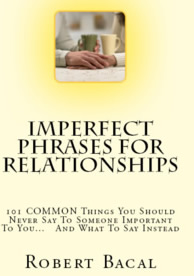
101 phrases you should never use with someone you care about, and what to say instead. Click the image to learn more from the Amazon page.
Available In
Improving Conflict and Communication Skills
Newest Conflict Help Articles
Learn To CUT DOWN Conflicts At Work
Improve work relationships by reducing conflict and using cooperative communication techniques

All Couples Should Learn To FIght Fair. Here's How
Check out our mini-guide on how to fight fair, and stop letting badly handled conflict cause pain in your relationships. Download it NOW!
Search Our Network Of Business and Personal Development Sites
Conflict Management - where the ancient and the modern meet
Managing Conflict, in Life & Work: Using Ancient and Modern Approaches
Summary: A fascinating and useful discussion of managing conflict bringing together ancient wisdom and philosophy with modern day thinking on conflict management. Draws from Sun Tzu (The Art of War), Stephen Covey, and Zen.
“Conflict” is a word that can have varying degrees of severity, meaning, and implication for each individual or circumstance. For example, the conflict that is experienced in our current, daily lives seems insignificant in comparison to the Samurai, or those in war, who faced death on a regular basis. However, it is still important to extrapolate the significant lessons that have been derived from such severe scenarios, as these notions are still applicable in the conflict that we experience in the workplace and life today.
Conflict is unavoidable, as each individual has unique and differing thoughts, ideas, and opinions. Therefore, it is important to learn ways to minimize and manage this difficulty, in order to ensure efficient and harmonious interactions. This article provides the genesis of a personal path, introducing tools and ways to minimize and manage conflict, while pointing to the origin of these concepts. After an overview of these modern and ancient approaches, a discussion will follow on applying successful tools and techniques for managing conflict. These ideas can be used to help clear the mind for better decision-making, and consequently, ensure a personal pathway to success.
New approaches to ancient concepts
Profound strategies and lessons to minimize and manage conflict have been around for thousands of years in forms such as the classic Chinese texts the “Book of Change – Tao de Ching” and the “Art of War”. Today, modern legends including Stephen Covey (“7 Habits for Highly Effective People”) and Dale Carnegie present similar corporate and personal tools. As many know the “7 Habits” is not a group of new concepts, but age-old approaches to success and conflict management, represented in a way that can be clearly applied to modern day personal and corporate development.
Discovering the origin & foundation of concepts
Although many of the true ancient concepts have been exaggerated or misused through incorrect interpretations, they can be applied in non-extreme forms relevant to the modern day from such arts as: Zen (which is not a religion, but a path for self discovery and growth), the “Art of War” by Sun Tzu (the classic text on strategy which is often regarded as the most definitive text on the topic), and the Tao de Ching (the “book of change”). These all provide profound lessons for leadership, change, success, peace of mind and conflict management.
A workplace example – an tense group meeting debating a topic
If one has to enter a meeting with a number of staff peers on a topic that is likely to require an intense debate, a strategy can be put into place to help provide a successful outcome (this should be combined with the other approaches outlined below). For example, one can approach the members of the meeting individually prior to the meeting to convey your preferred position. Once the meeting has started you will hopefully already have likely confrontational people already “on-side” to achieve your desired outcome in a non-confrontational way.
The Key to Managing Conflict: bringing it all together, and applying it today
All the above methods (old and new) are about changing core behavior and approaches, in order to avoid conflict and simultaneously achieve personal success.
As Sun Tzu states:
“If you know yourself and know others – you will be successful.
If you know others and not yourself, you will win one and lose one.
If you do not know others and do not know yourself, you are destined for failure in every battle.”
These are core values, and far more important than putting band-aids on problems, or approaching things with simply a short-term change. In regard to the ancient philosophies, they of course must be interpreted, and applied, using case studies and real world examples in a context that matches the modern corporate world. Applied Zen (www.AppliedZen.com) is a company that provides workshops, and downloadable videos online, regarding these exact topics with a unique approach. This is achieved through implementation of physical interaction drills to reinforce the concepts covered in workshop presentations. Studies have shown that learning conflict management based on physical as well as mental practice greatly increases the participants’ retention, and consequently, aids in implementation (more than 2 to 3 fold improvement).
Aggressive escalation of conflict
Conflict is derived from many circumstances, but quite regularly it can be escalated because of a person’s approach to the situation. In the Japanese language, there are two words that help to describe this: aiki and kiai. These words are derived from the same two characters, and are simply reversed to convey an opposite meaning. Kiai is a form of showing intensity and channelling it towards an individual, and in the martial arts ‘kiai’ is a very loud, expulsion of air and voice to intimidate or scare an opponent. Aiki is the opposite of head-to-head approaches and allows one to avoid escalating conflict (hence the martial art “Aiki-do”). Yet the approach still incorporates assertiveness a key attribute in any successful negotiation. Consider for a moment which concept would be most beneficial in dealing with conflict in a meeting at work or your personal life: kiai, or aiki?
“Show softness yet engage the opponent with hardness. Show weakness yet engage with fluid strength”
Obviously aiki is more practical, and will produce a more desired outcome. If we listen with the intent to understand - not to respond, if we get all our thoughts together before we confront another person, we can strategically work with someone to maintain our own balance and not produce antagonism in the person with whom we are dealing.
“Reaching a centered state, so I can perform at my best”
Having an open mind, and a relaxed physical and mental state will ensure I have an approach which is non-confrontational and provide a first step to maganging or avoiding conflict. An approach of aligning your thoughts and actions, and taking a moment to breathe and release tension, will create a more relaxed state within yourself as well as the person you are dealing with. This approach will enable you to convey your points in a way that your opponent will be unable to avoid or refuse. Settling oneself creates a calm and open mind: you are able to listen, think, and respond (in this order), and this is positively received by others. If you are able to settle yourself at any point (i.e. before, during, or after you feel aggression arising), others will respond to your calm, open mind, and it will put them into the same relaxed state. In various physical arts the importance of relaxed upper body, a low center of gravity and appropriate breathing creates this state. Zen and other conflict relevant arts have such Japanese terms such as “mushin”, “mizu no kokoro” and using the “hara” (stomach area) for creating and optimal physical state for mental performance.
Conflict within oneself – perhaps the most important conflict to understand Lessons such as “trying to defend/attack too many areas at once leaves the troops divided and weak” from Sun Tzu can be translated to an individual. Just as Stephen Covey asks, “How thin can you spread yourself before you are no longer there?”. Applying such lessons to your life today can have a profound impact on personal conflict – don’t take on more than you can handle, or you will begin to sacrifice the very essence of who you are. Although it is not direct conflict between two people, it is still relevant. If you have conflict within yourself, you are destined to have conflict with others. You will understand that conflict is not merely the apparent external problems – it also involves each individual and his/her conflicts within.
Sharpen the sword… This article provides and introduction to some of the methods and principles used in Applied Zen corporate training (www.AppliedZen.com). Businesses and individuals everywhere are using these philosophies to manage conflict more effectively and to achieve success. Therefore, it is essential to train one’s skills & endure ongoing development. As the ancient Samurai saying states, “Continuously sharpen the sword, or it will go blunt!”
Definition of Conflict, Merriam/Webster Dictionary: 1 : FIGHT, BATTLE, WAR 2 a : competitive or opposing action of incompatibles : antagonistic state or action (as of divergent ideas, interests, or persons) b : mental struggle resulting from incompatible or opposing needs, drives, wishes, or external or internal demands 3 : the opposition of persons or forces that gives rise to the dramatic action in a drama or fiction
Copyright 2005 - Dr. Jason Armstrong and Dana Buchman
Jason Armstrong, Ph.D., has worked at CEO levels in Japan, the USA, & Australia. He has also consulted for large multi-national companies in Japan and has specialized in the "Art of War" for more than 20 years. His merging of Asian strategy and the business world was further developed by living with a Japanese budo master. In the last 6 years he has consulted with Japanese companies such as Mitsubishi Pharmaceutical and been General Manager of a US company in Tokyo. He has worked in both Biotech and Venture Capital Industries. Today he runs http://www.AppliedZen.com, which provides online leadership training courses and conducts workshops in the USA Australia and Japan.
Article Source: http://EzineArticles.com/