 Manage Conflict - Resolve Conflict - Prevent Conflict
 Menu
- Our Conflict Management Tools
- FREE: A Brief Conflict-Provoking Communication Self-Assessment
- Conflict Articles By Bacal
- Mega Conflict Management Library
- Guest Contributions - Conflict Management and Conflict Resolution
- Free Instructional Videos On Conflict
- Browse Our Conflict Related Mni-Guides
Stop Harming Your Relationship With Your "Big Mouth"
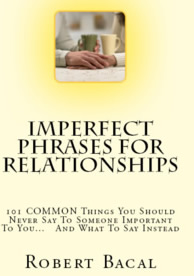
101 phrases you should never use with someone you care about, and what to say instead. Click the image to learn more from the Amazon page.
Available In
Improving Conflict and Communication Skills
Newest Conflict Help Articles
Learn To CUT DOWN Conflicts At Work
Improve work relationships by reducing conflict and using cooperative communication techniques

All Couples Should Learn To FIght Fair. Here's How
Check out our mini-guide on how to fight fair, and stop letting badly handled conflict cause pain in your relationships. Download it NOW!

Search Our Network Of Business and Personal Development Sites
Step-by-step conflict resolution guide.
Conflict Is Cool By Tom Shaw
Summary: A step-by-step guide to turning destructive conflict into productive conflict and success. Covers nullifying emotions, respect, commitment, listening, and other important parts of the conflict resolution process.
Having experienced more than my fair share of conflict over the years, from street fighting to more sophisticated law cases, I have become an avid student of the subject of Conflict Resolution. My bookshelves are full of literature on the topic and the public library is thinking of charging me for overuse.
When I feel challenged through being in disagreement with someone I care about, I get comfort by remembering an appropriate little cliché that I picked up some years ago. It goes something like “If two people were in 100% agreement on everything, one of them would be superfluous.”
By accepting this, I give myself permission to get involved in the conflict fully, knowing that there is a lesson to be learned.
Regardless of the number of pages in a book, and many of them are well padded, they mostly seem to recommend a procedure such as the following:-
1. Nullify emotion
2. Explore the reasons for the conflict
3. Consider alternatives
4. Agree on most appropriate
5. Implement the chosen one
6. Evaluate the solution.
I intend to go through each step in detail, but before doing so I believe that there are several pre-requisites or ground rules that need to be agreed to by both parties before the process can even begin. The proposition that “All’s fair in Love and War” seems to me like an open ticket to abuse.
Rule 1: Respect:
Both parties may well loathe the sight of each other, but if they choose to address the conflict, they must agree to acknowledge that
(i) NEITHER of them are PERFECT and
(ii) each will have their own set idiosyncracies
TO WHICH EACH IS ENTITLED.
Rule 2: Commitment:
If the conflict is serious enough to warrant resolution, it is essential that full commitment be given to a mutually satisfying outcome.
Rule 3: Mission statement:
In a business where there exists a formal Mission Statement, this can be of great use in deciding the relevance or importance of each party’s assertions. If the relationship is informal, i.e. outside business, then actually defining a mission statement can work wonders too. This doesn’t need to be formal document signed in blood, but the greater clarity each party has on the other’s needs and wishes, the more likely is it that the relationship will flourish.
Rule 4. Preparedness to listen:
The old story about two ears and one mouth is absolutely true – how many times have you heard someone being denigrated because they “listen too much”. For resolution to be successful both sides must feel validated, that they have truly got their whole story across.
There are many barriers to listening but probably the most common is the tendency for us to “switch off” before the other party has finished. Usually it is because we “know what they’re going to say” and devote our attention to formulating our reply. The result of this is that the “listener” really only gets part of the story and the “speaker” is left feeling invalidated and frustrated. In an effort to be heard voice levels are raised, and the whole transaction deteriorates to the lowest level of disrespect.
There are quite a few other barriers to listening, and to go into these in detail would easily fill this whole publication. For the purpose of this article I would only suggest that “Poor Listening Skills” is an affliction that affects most of us. It is my view that just by consciously working to improve our own ability to listen would reduce the need for formal resolution greatly.
Having established our own Marquis of Queensbury rules, we can now get back to the proposed system. The first step of nullifying emotion is much easier said than done. It is a highly contentious issue, which we shall explore in some depth
Step 1 Nullify emotion
Unfortunately, the first step of the procedure is more easily said than done. What do we do when, at an intellectual level, we know that we should argue our case in a calm, logical manner, but what we really want to do is to reach out and choke the living daylights out of our opponent? Alternatively, we may just feel like bursting into tears at the sheer unfairness of it all.
But in today’s society we have learned that neither of these responses is acceptable. And if we should happen to give way to our impulses, we are considered unstable or just plain weird. So we bottle it up, count to ten, breathe deeply, and tell ourselves that we are being too emotional.
At least that’s what “civilised” people do. But which of these two types of behaviour is more honest? If we feel angry or upset, isn't’ that our TRUTH? And by denying these emotions aren’t we being untruthful? I suggest that that is exactly the case. We have become so used to denying our feelings that many of us simply don’t know who we are. The word DENIAL is an interesting acronym for Don’t Even Notice I Am Lying.
So am I suggesting that when things don’t go our way that we just give vent to whatever our emotion is at that time? And never mind who gets in the way? Absolutely not! What I am proposing is that we can OWN our feelings, without harming anyone else.
Nowadays it is commonly accepted that feelings which have been repressed or ignored do not just simply go away. They lie beneath the surface of our awareness waiting their opportunity to see daylight. The problem is that keeping them suppressed is like holding a beach ball under water. The effort that we spend holding it down drains us of energy that we could use in other ways. We may successfully keep them in check throughout our youth, but by middle years this can really take it’s toll. So what do yesterday’s feelings have to do with conflict in the present? Well, when we find ourselves involved in a disagreement and emotions starting to rise, maybe the problem lies not in what is going on at the moment; maybe it’s our “History Buttons” being pushed.
The term stress has at last been given some respectability, but here again we tend to blame factors outside ourselves. My boss is always this; my wife is forever that. If we can find a reason for the problem externally, it keeps us from looking at the real issues. When we perceive the other party as “making us angry”, then obviously we will respond defensively. So how can we tell whether our discomfort is caused by the current situation or something from the past being triggered? One of the really big clues comes when we can recognize a pattern. How many times have you been left with a feeling of déjà vu? Life has a way of re-creating difficult situations in order to give us the chance to learn.
This “Blame-The-Other-Guy” culture has prevailed so far because we haven’t had the level of self-awareness necessary to help us learn personal responsibility. But it isn’t just science and technology that are evolving. Nowadays there are many tools and methodologies to help us learn how to behave reflectively.
So, when involved in conflict, instead of just breathing deeply and waiting for the feeling to pass, we can actually use the opportunity to reflect. While counting up to 10 (or 100 if that’s what it takes), we can try to think back to past occasions when we felt the same way. This is not an easy task for anyone, but if conflicting parties can both adopt this philosophy, not only will they open the way for a win-win outcome, but also the relationship itself is also likely to benefit.
I think most people would agree that the term “nullify emotion” is much easier said than done. Nevertheless, we can at least see by now how to make use of our emotions as they get triggered during conflict. In summary, if we recognise through awareness that our feeling (in the moment) is out of proportion to what the situation itself demands, then our history buttons are being pushed.
Step 2 Explore the reasons for the conflict
Once again, this may not be as easy as it seems. What may start off as a disagreement over whether the lid should be left up or down can often be merely a symptom of a much deeper problem. In long-term relationships, where the number of petty disagreements seems to have multiplied, then it is almost certain that there are deeper issues involved. Unless both parties have extremely high self awareness and a pre-agreed arrangement to “Put the Relationship before Self” then 3rd party mediation may be necessary.
In less intense transactions, such as occur at work or in business, the disagreement may be just what it seems.
I love the story about the two teenage sisters fighting for the only orange in the house. Each was absolutely certain that her need was greater than her sibling’s. It was only when good old Mum stepped in to mediate that a win-win solution was found. After a brainstorming session it was discovered that one girl wanted some fresh orange juice and the other wanted to bake an orange cake, requiring only the rind.
So during this investigation stage the objective is to amass as much relevant, and perhaps seemingly irrelevant, information as possible. If both parties are committed to the process, they may spur each other on to be as creative as possible.
Step 3 Consider alternative courses of action
With any luck, some of the hostility and intensity will have evaporated by this stage, and an element of cooperation may have found its way in to the process. Rather than having only two completely polarized possibilities, on offer at the moment is a whole smorgasbord of opportunities. From this list of possible solutions, each item can be prioritized in accordance to its likelihood of solving the problem.
Step 4 Agree on the most appropriate course of action
When the most appropriate course of action may not be immediately obvious, there is a useful exercise that can be carried out that will almost guarantee a solution. It is very simple to try, and is also a great indicator of how committed each party is to the greater good.
The exercise involves each party acting as lawyer for the opponent. Party 1 uses as much logic, imagination and creativity to ensure that Party 2’s point of view is fully represented. Party 2 then reciprocates on behalf of Party 1. While there are no guarantees in life, this is one of the most effective tools I have ever seen used.
Step 5 Implement and Monitor
This final step is virtually self-explanatory. Once the most appropriate course of action has been chosen, it is just a matter of implementing it. If part of the resolution involves behaviour changes, then monitoring is essential. The more ingrained the conflict, the longer time may be needed to reinforce the different actions that have been agreed upon. If on the other hand, either party has gained sufficient insight for them to realise that their behaviour has been inappropriate, they may easily make the choice to consciously ‘do it differently’.
Summary
This effort to condense a topic such as this to less than 2000 words has been very ambitious. If any two people thought and behaved in exactly the same way, then one of them would be superfluous. It is our diversity that helps make the world such an interesting place. And if we can implement some of the ideas that I have been espousing here, such as listening with respect, then perhaps we can help make life a little more harmonious.
About the author:
I am a certified trainer and experienced life coach. My wife & I have been together for 32 years, and we are the proud parents of two magnificent children. My career included 18 years as an electronics technician and 5 as a computer programmer, (back in the bad old days of COBOL). While these occupations provided lots of intellectual stimuli, I somehow never really achieved much real, meaningful satisfaction. About 18 years ago I discovered the pleasures, and sometimes pain, that the journey of Self-Discovery can bring.
As a Coach I specialise in helping people who experience difficulties developing or maintaining long-term relationships, or those seeking to find greater satisfaction in their careers. If you are serious about making changes in your life, please get in touch.
Email: tom.shaw@gettingrealseminars.com
Website: http://gettingrealseminars.com
"...you are what you CHOOSE to become."